A procurement requisition for “navigation lights” without a vessel length attached is not a specification—it is a placeholder. The single variable that changes more navigation light decisions than any other is regulatory length, and it changes them in three places at once: which lights must be exhibited, how far each light must be visible, and how high or how separated each fixture must be mounted.
The confusion usually surfaces in a practical form. A superintendent ordering replacement sidelights for a 48-metre vessel and a 52-metre vessel may assume the same fixture will serve both. The supplier may quote the same family. The certificates may look similar. But the 52-metre vessel sits in a different Rule 22 visibility band for sidelights (3 nautical miles rather than 2), and if it is a power-driven vessel it is obliged to carry a second masthead light that the 48-metre vessel is not. The fixture that satisfies the smaller vessel may not carry the approval, the intensity, or the arc needed for the larger one.
This guide works through the three length-driven decision layers—configuration, visibility range, and installation geometry—so that a specification can be built from the vessel’s particulars rather than from a product catalogue. The broader rule context, including daylight signalling and vessel-status configurations, is set out in the complete navigation light selection guide; this article focuses specifically on the length variable.
COLREGs does not apply a continuous curve from small craft to large ships. It creates discrete bands, and the band boundaries are where most specification errors occur.
Under 12 metres. This band carries the most permissive rules. A power-driven vessel under 12 metres may exhibit an all-round white light and sidelights in lieu of the full Rule 23 configuration. The masthead light (or the substituting all-round light) must be carried at least one metre higher than the sidelights, and sidelights may be combined in one lantern on the centreline. The visibility requirement is modest: masthead 2 n.m., sidelights 1 n.m., sternlight 2 n.m. for vessels under 12 metres.
12 metres to under 50 metres. This is the band where the second masthead light becomes available but not obligatory. Rule 23(a)(ii) requires a second masthead light abaft of and higher than the forward one, “except that a vessel of less than 50 meters in length shall not be obliged to exhibit such light but may do so”. The visibility requirements step up: masthead 5 n.m., except that a vessel under 20 metres needs 3 n.m.; sidelights 2 n.m.; sternlight 2 n.m. for vessels of 12 metres or more but under 50 metres. The installation rules change as well: a 12–20 metre vessel’s masthead light must be at least 2.5 metres above the gunwale, while a vessel of 20 metres or more moves to the height-above-hull regime with a minimum of 5 metres and a possible breadth-related increase.
50 metres and above. Here the rules harden. The second masthead light is mandatory. The full visibility ranges apply: masthead 6 n.m., sidelights 3 n.m., sternlight 3 n.m., all-round lights 3 n.m.. The installation geometry becomes more demanding: with two masthead lights carried, the after one must be at least 2 metres vertically higher than the forward one, and the vertical separation must be such that in normal trim the after light is seen over and separate from the forward light at 1,000 metres from the stem when viewed from water level.
The 50-metre boundary is not a rough guide. It is the line at which a permissive requirement becomes a mandatory one, and at which the visibility range for sidelights and sternlights increases by 50 percent. A vessel at 49.9 metres and a vessel at 50.1 metres may look identical from the quay, but they sit in different specification regimes.
The table below consolidates the Rule 22 minimum ranges by band. These are the performance thresholds against which a fixture’s type approval is granted, and a datasheet that does not state the range at the nominal supply voltage is an incomplete specification.
| Light type | Vessel < 12 m | Vessel 12 m to < 50 m | Vessel ≥ 50 m |
|---|---|---|---|
| Masthead light | 2 n.m. | 5 n.m. (3 n.m. if < 20 m) | 6 n.m. |
| Sidelight (each) | 1 n.m. | 2 n.m. | 3 n.m. |
| Sternlight | 2 n.m. | 2 n.m. | 3 n.m. |
| All-round light (white, red, green, yellow) | 2 n.m. | 2 n.m. | 3 n.m. |
Source: Rule 22 minimum visibility ranges as published in 33 CFR § 83.22.
The practical translation for a buyer is that the visibility range is not a “good to have” number that sits alongside a product’s price. It is the number that determines whether the fixture belongs in the candidate pool at all. A 3 n.m. sidelight cannot be substituted onto a 50-metre vessel’s requirement for a 3 n.m. sidelight if its certificate covers only the 2 n.m. configuration; the model designation on the certificate must match the model being supplied, and the certified range must meet or exceed the band’s minimum.
There is a second, less obvious length-driven trap. The 12-to-under-50 band contains a nested sub-band at 20 metres for masthead visibility (5 n.m. versus 3 n.m.) and another at 20 metres for installation height (2.5 metres above gunwale versus the height-above-hull regime). A vessel at 19 metres and a vessel at 21 metres are in the same “12–50” regulatory band for the second-masthead question, but in different sub-bands for visibility and mounting. This is why a specification that records only “12–50 metres” is not granular enough; the vessel’s actual length, not just its band, should be recorded.
The configuration question is not simply “how many lights,” but “which lights are obligatory, which are optional, and which alternatives are permitted.”
For a power-driven vessel under 12 metres, the permitted alternative—an all-round white light plus sidelights—is a genuine configuration choice, not a lesser version of the Rule 23 arrangement. A buyer specifying for this band should confirm whether the operator intends to use the alternative or the full configuration, because the fixture count and mounting arrangement differ.
For a vessel of 12 metres or more but under 50 metres, the forward masthead light, sidelights, and sternlight are the baseline. The second masthead light is optional. If the owner elects to fit it—as many commercial operators do for redundancy or fleet consistency—the installation geometry for two mastheads still applies, and the vessel is no longer in a simple single-masthead arrangement. The decision to fit an optional light is therefore also a decision to meet the installation standard for that light.
For a vessel of 50 metres or more, the baseline configuration includes the forward masthead, the after masthead, sidelights, and sternlight. There is no “light” version of this configuration available under Rule 23. The double-deck construction used in some commercial families reflects this operational reality: a fixture with two lamp positions in one housing provides a degree of continuity if one lamp fails, without changing the arcs or the mounting geometry. The double-deck configuration used for vessels at and above the 50-metre threshold illustrates how a product family can map a specific model to a specific length band and visibility set—starboard and port at 3 n.m. over 112.5°, masthead at 6 n.m. over 225°, sternlight at 3 n.m. over 135°—rather than offering a single fixture across all bands.
The configuration boundary 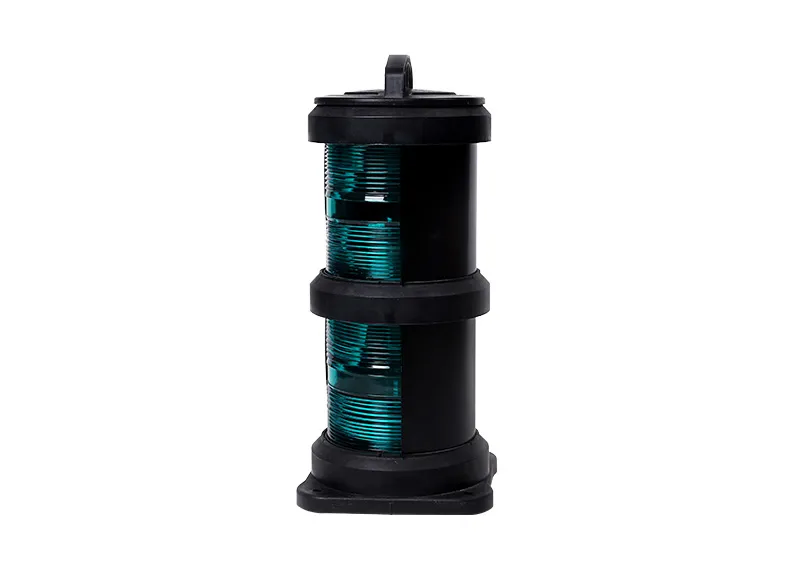 at 50 metres also interacts with vessel type. A towing vessel, a fishing vessel, or a vessel not under command has a different configuration question even at the same length. The application-level differences across commercial shipping navigation show how the same length band can produce different signalling equipment inventories once the vessel’s operational mode is brought into the specification.
The third length-driven layer is the one most often left to the yard rather than the procurement file, and it is where a correctly purchased fixture becomes a non-compliant installation.
For a power-driven vessel of 20 metres or more, the forward masthead light must be at least 5 metres above the hull, and if the vessel’s breadth exceeds 5 metres, at least at that breadth, up to a maximum of 8 metres. This is a height-above-hull requirement, not a height-above-deck or height-above-bulwark requirement. A fixture that is physically capable of being mounted at that height but whose bracket, base, or cable entry is designed for a lower rail mounting may not be installable without modification.
When two masthead lights are carried—mandatory at 50 metres and above, optional but permitted below—the after one must be at least 2 metres higher than the forward one, and the pair must satisfy the 1,000-metre visual separation test. On a vessel just over 50 metres, this often constrains the choice of mast structure more than the choice of fixture. A buyer who specifies a 6 n.m. masthead light and a 3 n.m. sidelight but has not confirmed that the mast drawing provides the required vertical separation has specified a photometrically correct but geometrically non-compliant installation.
The 12-to-under-20 sub-band has its own simpler geometry: masthead at least 2.5 metres above the gunwale. The under-12 band requires the masthead or all-round light at least one metre above the sidelights. These are not interchangeable standards. A vessel that moves from 19 to 21 metres on a stretch conversion moves from a gunwale-height rule to a hull-height rule, and the existing mounting position may not satisfy the new requirement.
The practical procurement conclusion is that the installation geometry belongs in the RFQ, not only in the installation drawing. A supplier quoting a fixture for a 50-metre-plus vessel should be asked to confirm the mounting interface, the base dimensions, and the minimum separation achievable with the quoted bracket—not merely the photometric performance of the lamp.
Error 1: Recording the vessel’s “class length” rather than its regulatory length. The length that triggers Rule 22 and Rule 23 is not necessarily the length on a marketing brochure or a general arrangement drawing. It should be confirmed against the load line or tonnage certificate, because a vessel near a band boundary may fall on the wrong side of it.
Error 2: Treating the 12–50 band as a single specification. The nested 20-metre thresholds for masthead visibility and mounting height mean that a 19-metre vessel and a 35-metre vessel do not share the same masthead specification. A band-level specification without the actual length is a partial specification.
Error 3: Buying a certified fixture and assuming the installation will be compliant. The 2-metre vertical separation, the 1,000-metre visual separation test, the height-above-hull requirement, and the height-above-gunwale requirement are installation conditions. A fixture that meets its visibility range on a test bench can still fail the installation geometry on the vessel.
Error 4: Specifying the optional second masthead light without resourcing the geometry. A vessel under 50 metres that elects to carry a second masthead light takes on the installation standard for two mastheads. The optional nature of the light does not make the separation requirement optional once the light is fitted.
Error 5: Assuming a single fixture family covers all bands. A commercial family may have models mapped to different length bands, but the model-level approval is specific to the arc and range. The correct question is not “does this series cover my vessel?” but “which model in this series carries the approval for my vessel’s band, arc, and range?” For fleets that span the 50-metre boundary, this usually means specifying two distinct model sets rather than stretching one set across the fleet.
What changes at the 50-metre boundary?
The second masthead light becomes mandatory rather than optional, the visibility ranges for masthead, sidelights, sternlight, and all-round lights increase (masthead to 6 n.m., sidelights and sternlight to 3 n.m.), and the vertical separation and visual separation requirements for two masthead lights apply in full.
Is the second masthead light optional below 50 metres?
Yes. Rule 23(a)(ii) exempts vessels under 50 metres from the obligation to carry it, while permitting them to do so. If fitted, the two-masthead separation requirements still apply to the installation.
What is the visibility requirement for a masthead light on a 19-metre vessel versus a 35-metre vessel?
Both are in the 12-to-under-50 band, but a vessel under 20 metres has a 3 n.m. masthead requirement, while a vessel of 20 metres or more has a 5 n.m. requirement. The 20-metre line also marks the shift from the gunwale-height rule to the height-above-hull rule for installation.
Can a sidelight approved for 2 n.m. be used on a 50-metre vessel?
No. A vessel of 50 metres or more requires a sidelight visible at 3 n.m. The model’s type-approval certificate must cover the 3 n.m. configuration, and the model designation on the certificate must match the model supplied.
Does a vessel under 12 metres have to use the full Rule 23 configuration?
No. It may exhibit an all-round white light and sidelights in lieu of the full configuration. If the full configuration is used, the standard masthead and sidelight requirements apply, but the visibility ranges are the lower under-12 ranges.
How high must a masthead light be on a 30-metre vessel?
On a power-driven vessel of 20 metres or more, the forward masthead light must be at least 5 metres above the hull, and if the breadth exceeds 5 metres, at least at that breadth, up to a maximum of 8 metres. The 2.5-metre-above-gunwale rule applies only to vessels of 12 metres but under 20 metres.
Once the vessel’s regulatory length, its configuration in each operating mode, and its installation geometry are established, the remaining work is a model-level comparison against the certified arcs and ranges. That comparison is where a family like the CXH series navigation signal lights becomes relevant: the series includes single-deck and double-deck variants across the length bands, and the model-level pages state the arc and visibility range for each function rather than collapsing them into a single generic rating.
The logical next step is to take the vessel’s particulars—regulatory length, vessel type, operating modes, and mounting constraints—and use them as the filter for which models in the series are eligible, rather than starting from a preferred model and working backwards. If that mapping needs a second pair of eyes, the technical contact page is the appropriate place to put the vessel’s length band and configuration on record; it is a technical review route, not a pricing request, and the useful inputs are the vessel’s load line length, its Rule 23 or Rule 24 configuration, and the mast or bulwark arrangement available for mounting.
Masthead Light Height and Separation: The Installation Geometry Buyers Inherit
Marine Navigation Lights: A Complete Selection Guide for Commercial Vessel
Are Navigation Lights Required During the Day? Understanding COLREGs Requirements
This article is part of ZHIYUE’s technical content library. No direct sales or pricing information is included. All technical discussions aim to help you make informed purchasing decisions.
GET A QUOTE