

A navigation light is one of the few pieces of equipment on a commercial vessel that is judged not by how well it works in normal conditions, but by whether it satisfies an exacting legal and technical standard at the moment another vessel needs to see it. A masthead light that is 0.5 metres too low, a sternlight wired with the wrong lens, or a “COLREGs-compliant” fixture that lacks a valid type-approval certificate can turn a routine port state inspection into a detention, and—far worse—can remove the visual cue another officer of the watch is relying on to avoid collision.
This guide is written for the people who actually make navigation light decisions: technical superintendents specifying equipment for a newbuild, procurement managers evaluating RFQs, and fleet engineers standardising a mixed-age fleet. It works from the outside in. First, what the light is for. Then, what COLREGs actually requires for a given vessel type and length. Then, how to translate those requirements into a specification that a supplier can quote against, and an installation that a yard can execute without introducing non-compliance at the final step. The Navigation Signal Light product family is used throughout as a worked example of how a commercial series maps to those requirements.
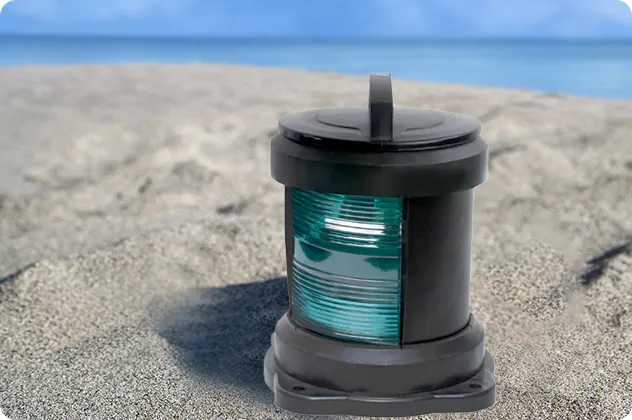
Marine navigation lights are the externally visible lights that a vessel exhibits to announce its presence, its heading, its type, and—in some cases—its operational status to other vessels. They are not general-purpose illumination. A floodlight that lights up the deck for cargo operations serves a different function from a masthead light whose 225-degree arc is calibrated to be visible at 6 nautical miles. The two should never be substituted for each other, and a navigation light should never be selected purely on the basis of brightness.
The regulatory logic behind these lights is subtractive rather than additive. Each light tells an observer what the vessel is not as much as what it is. A white masthead light forward and a second masthead light abaft and higher tell an approaching vessel that this is a power-driven vessel underway, likely 50 metres or more in length, with a heading that can be inferred from the geometry of the two lights. Red and green sidelights tell the observer which side of the vessel is facing them, and therefore who is the stand-on vessel and who must give way. A sternlight closes the loop, confirming that the observer is looking at the vessel from astern rather than from ahead. Remove any one of these elements, or distort its arc or visibility range, and the entire interpretive chain weakens.
This is why navigation light selection is a configuration problem before it is a product problem. The question is not “which navigation light is best,” but “which combination of lights, with which arcs, visibility ranges, colours, and mounting geometry, does COLREGs require for this specific vessel?” Only after that configuration is fixed does the product selection begin. The commercial vessel and offshore application pages show how those configurations differ between a harbour tug, a bulk carrier, and a standby vessel—a useful reality check before a specification is written.
The practical consequence for procurement is that a navigation light datasheet must be read against a vessel’s particulars—length, type, mode of operation—rather than treated as a generic catalogue item. A fixture marketed as a “marine navigation light” may be perfectly suitable for a 15-metre harbour craft and wholly unsuitable for a 180-metre bulk carrier, not because of build quality but because its arc, intensity, and visibility range were designed for a different regulatory band.
COLREGs establishes two separate but linked requirements that together define whether a navigation light is acceptable: which lights must be exhibited, and how far each light must be visible. Both are functions of vessel type and length, and both must be satisfied simultaneously.
Rule 23 is the starting point for the majority of commercial vessels. A power-driven vessel underway must exhibit a forward masthead light; a second masthead light abaft of and higher than the forward one; sidelights; and a sternlight. The second masthead light is mandatory for vessels of 50 metres or more in length; vessels under 50 metres are not obliged to carry it but may do so. Vessels under 12 metres in length may substitute an all-round white light and sidelights for the full Rule 23 configuration.
This is where the first common procurement error occurs: treating the second masthead light as an optional accessory on a vessel that is, in fact, 50 metres or longer. Length must be confirmed against the vessel’s load line or tonnage certificate, not estimated from a general arrangement drawing.
Rule 22 sets the minimum visibility ranges that each light must achieve. These are not recommendations; they are the performance thresholds against which the light’s intensity and lens design are type-approved. For vessels of 50 metres or more in length, a masthead light must be visible at 6 nautical miles, a sidelight at 3 miles, and a sternlight at 3 miles. For vessels of 12 metres or more but less than 50 metres, the masthead light requirement is 5 miles (reduced to 3 miles for vessels under 20 metres), sidelights 2 miles, and sternlight 2 miles. For vessels under 12 metres, the masthead light is 2 miles, sidelights 1 mile, and sternlight 2 miles.
These ranges apply to all-round lights as well: 3 miles for vessels of 50 metres or more, 2 miles for smaller vessels. A white, red, green, or yellow all-round light on a 50-metre vessel that is only visible at 2 miles does not satisfy Rule 22, regardless of how bright it appears to the eye at close range.
The practical takeaway is that “visibility range” on a datasheet must be traceable to a test method and a reference voltage. A supplier that lists “3 n.m.” without specifying the nominal voltage at which that range was measured is providing an incomplete specification. Voltage drop on a long cable run to a masthead light can reduce intensity below the certified threshold, a point developed further in the electrical section below.
Red and green are not decorative choices. Rule 21 defines sidelights as a green light on the starboard side and a red light on the port side, each showing an unbroken light over an arc of 112.5 degrees. The colour coordinates must sit within the chromaticity boundaries of the applicable standard. This matters most when LED retrofits are considered: a high-efficiency white LED that produces a slightly greenish or bluish white may fail the colour test for a masthead light even though it is visibly “white” to an observer.
For each vessel, the compliance file should record four things before any RFQ is issued: the vessel’s regulatory length and type; the Rule 23 (or Rule 24, 25, 26, or 30) configuration that applies; the Rule 22 visibility range for each light position; and the required arc for each light. A supplier quoting without those four data points is guessing, and a buyer accepting a quote without them is accepting an unverified configuration.

The five core light types below cover the majority of commercial vessel configurations. The table is a functional reference; it is not a substitute for the specific Rule and Annex I requirements that apply to a given vessel.
| Navigation Light Type | Primary Function | Typical Position |
|---|---|---|
| Masthead Light | Indicates forward direction and vessel status; white, 225° arc | On the fore-and-aft centreline, forward; second masthead abaft and higher on vessels ≥50 m |
| Port Sidelight | Indicates port side; red, 112.5° arc | Port side, above the sheerline |
| Starboard Sidelight | Indicates starboard side; green, 112.5° arc | Starboard side, above the sheerline |
| Sternlight | Indicates the vessel’s rear direction; white, 135° arc | As close as practicable to the stern |
| All-round Light | Provides 360° visibility; white, red, green, or yellow depending on function | Positioned where it can best be seen; function determined by the applicable Rule |
The definitions behind the arcs are precise. A masthead light is a white light over the fore-and-aft centreline showing an unbroken 225-degree arc, from right ahead to 22.5 degrees abaft the beam on either side. A sternlight shows a 135-degree arc, 67.5 degrees from right aft on each side. An all-round light shows an unbroken 360-degree arc. A towing light is yellow and has the same arc characteristics as a sternlight. A single-deck fixture such as the CXH1-3 navigation signal light is typical of the general-purpose end of this family, while special-purpose models cover narrower signal functions—the CXH7 Panama steering light, for example, is a dedicated directional signal rather than a general masthead or sidelight.

The two are sometimes conflated because both can be white and both can sit high on a mast, but they are functionally different. A masthead light’s 225-degree arc is forward-facing. An all-round light is visible from every direction. On a vessel under 12 metres, Rule 23 permits an all-round white light to replace the forward masthead light and, in some configurations, the sternlight as well. On a larger vessel, an all-round light serves a different function entirely: it may be an anchor light under Rule 30, a not-under-command light under Rule 27, or a special flashing light in a towing configuration. Selecting an all-round fixture where a 225-degree masthead light is required produces a light that is visible from astern when it should not be, and may fail the horizontal sector requirements of Annex I.
The buyer’s practical check is the arc marking on the fixture or datasheet. If the specification does not state the horizontal arc in degrees, the fixture has not been specified to a COLREGs function.
A power-driven vessel when towing must exhibit two masthead lights in a vertical line instead of the forward and after masthead lights prescribed by Rule 23; when the length of the tow exceeds 200 metres, three masthead lights in a vertical line are required. Sidelights and a sternlight are also carried, with a yellow towing light in a vertical line above the sternlight. This is a different configuration from the standard Rule 23 arrangement, and it changes the number and spacing of masthead fixtures on the vessel. A towing vessel specified with a single forward and single after masthead light, without provision for the vertical pair or triplet, will require rework at commissioning.
A vessel engaged in fishing exhibits two all-round lights in a vertical line, the upper green and the lower white, and—when making way through the water—sidelights and a sternlight in addition. A sailing vessel underway exhibits sidelights and a sternlight, with an optional red-over-green all-round light at the masthead. A vessel at anchor under 50 metres exhibits an all-round white light where it can best be seen; a vessel of 50 metres or more exhibits two all-round white lights, the forward one at least 4.5 metres above the after one and at least 6 metres above the hull.
These configurations are often bundled into a single vessel’s lighting plan if the vessel operates in multiple modes. A standby vessel that alternates between transit, station-keeping, and anchor duty may require three distinct configurations from the same set of fixtures. The selection question then becomes whether the fixtures can be switched or supplemented without compromising the fixed arcs and positions required for each mode.
The configuration table below translates the Rule-level requirements into a vessel-level selection view. It is deliberately simplified at the rule-reference level; the final configuration for any specific vessel should be confirmed against the applicable text of COLREGs and the vessel’s class and flag state requirements.
| Vessel scenario | Core light configuration | Critical selection consideration |
|---|---|---|
| Power-driven vessel ≥50 m, underway | Forward masthead, after masthead (higher), sidelights, sternlight | After masthead must be vertically separated so it is seen over the forward light at 1,000 m; masthead visibility 6 n.m. |
| Power-driven vessel 12–<50 m, underway | Forward masthead, sidelights, sternlight; second masthead optional | Masthead visibility 5 n.m. (3 n.m. if <20 m); confirm whether the operator elects the optional second masthead |
| Power-driven vessel <12 m, underway | All-round white light + sidelights (alternative to Rule 23 configuration) | All-round light must be at least 1 m higher than sidelights |
| Power-driven vessel towing, tow ≤200 m | Two masthead lights in vertical line, sidelights, sternlight, yellow towing light above sternlight | Vertical spacing and lowest-light height must be planned on the mast drawing |
| Vessel engaged in fishing | Two all-round lights in vertical line (green over white); sidelights and sternlight when making way | Lower all-round light height relative to sidelights is prescribed; fixture selection must accommodate the vertical pair |
| Vessel at anchor <50 m | All-round white light where best seen | One fixture, but position must be unobstructed through 360° |
| Vessel at anchor ≥50 m | Two all-round white lights, forward and after | Forward light at least 4.5 m above after light and at least 6 m above hull |
The most consequential distinction in this table is not between vessel types but between modes of operation. A vessel that is compliant underway may be non-compliant at anchor if the anchor light is an afterthought—a portable fixture clipped to a rail rather than a permanently installed, properly positioned all-round light. Fleet standardisation programmes that focus only on the underway configuration routinely leave anchor and towing modes under-specified.
Selection proceeds in a fixed order. Changing the order—for example, starting from a preferred product and working backwards to a vessel—is how mismatches enter a specification.
Step 1: Confirm the regulatory length and vessel type. Use the length that triggers the Rule 22 visibility band (under 12 m, 12 to under 50 m, 50 m and above). The length on a marketing brochure is not the regulatory length. Confirm against the load line certificate or the tonnage certificate.
Step 2: Fix the configuration. Determine which lights the vessel must exhibit in each operating mode, using the applicable Rule (23, 24, 25, 26, or 30) and the vessel’s classification. Record the arc for each position: 225° for masthead, 112.5° for each sidelight, 135° for sternlight, 360° for all-round.
Step 3: Set the visibility range for each position. A 50-metre vessel needs a 6 n.m. masthead light and 3 n.m. sidelights and sternlight. A 35-metre vessel needs a 5 n.m. masthead light and 2 n.m. sidelights and sternlight. Specify the range as a minimum at the nominal supply voltage, and require the supplier to state the test voltage and the intensity in candela.
Step 4: Establish the installation geometry. Masthead height above the hull, vertical separation between forward and after mastheads, sidelight height relative to the masthead and the sheerline, and the spacing of vertical light arrays all constrain which fixtures and mounting bases will work. A fixture that meets the photometric requirement but cannot be mounted at the required height is not a compliant selection. This is developed in the installation section below.
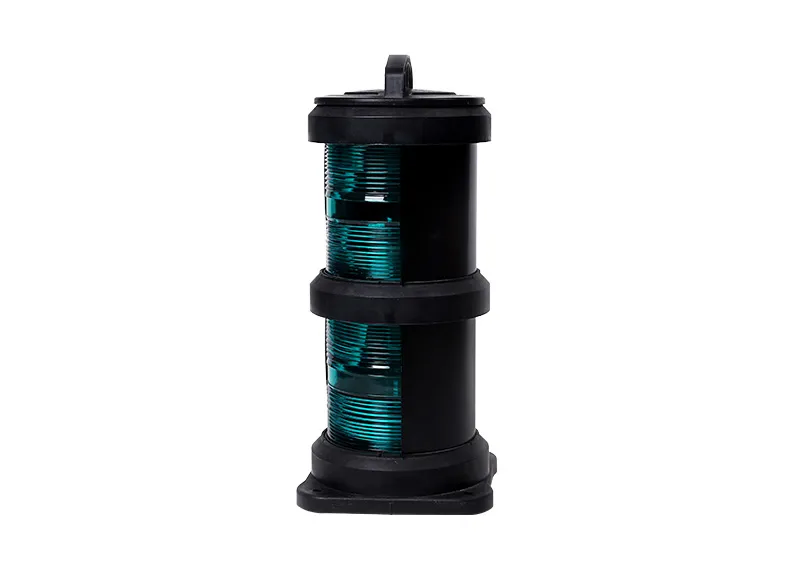
Step 5: Select the light source and electrical interface. Incandescent, halogen, and LED sources can all be compliant if the complete fixture is type-approved to the required standard. The source choice changes power consumption, maintenance interval, and heat output, but it does not change the arc or visibility requirement. The electrical interface—voltage, cable entry, terminal type—must match the vessel’s distribution system and the cable routing available at the mounting location. A double-deck unit such as the CXH1-101P is relevant here because it provides two lamp positions in one housing, so a single lamp failure does not immediately remove the required signal.
Step 6: Verify the compliance evidence. For commercial vessels, the relevant evidence is a type-approval certificate from a recognised classification society covering the exact model, not a generic “CE” mark or a manufacturer’s declaration. The certificate should state the arc, colour, visibility range, and nominal voltage for which the model is approved. Ask for the test report if the certificate references one.
The order matters because each step narrows the candidate pool. Starting with Step 5 (for example, “we want LED”) and working backwards often produces a fixture that cannot satisfy Step 4 (mounting geometry) or Step 6 (type approval for the required arc).
The marine environment attacks navigation lights from three directions at once: salt-laden moisture, ultraviolet radiation, and vibration transmitted through the mast or bulwark. Housing and protection decisions determine whether the fixture’s photometric performance survives the first year of service, let alone the five-year maintenance interval a fleet may plan for.
Ingress protection. For exterior deck-mounted navigation lights, IP66 is the practical minimum to withstand rain, spray, and high-pressure washdown; sealed compartments or hazardous zones may require a higher rating or a different protection concept altogether. The IP rating must apply to the complete fixture as installed, including the cable entry. A fixture rated IP66 with a cable gland that is not sealed to the same standard is not an IP66 installation. Cable glands, gaskets, and breather drains are part of the protection system, not accessories.
Housing materials. Marine-grade aluminium, bronze, stainless steel, and high-strength engineering plastics are all used in commercial navigation lights, and the correct choice depends on the mounting location and the maintenance regime. A painted aluminium housing on a forward mast sees different conditions from a bronze sidelight housing on a bulwark. The CXH1-101P, for example, uses a PA+GF (glass-fibre reinforced polyamide) shell with a PC (polycarbonate) lens, rated for operation from −30°C to 55°C. That material combination is appropriate for the fixture’s intended service on vessels of 50 metres or more, but the point for the buyer is to match the housing specification to the exposure, not to assume that one material is universally superior.
Vibration and temperature. Navigation lights mounted on masts experience continuous low-frequency vibration from engines and intermittent shock from sea impact. Incandescent filaments are vulnerable to both; LED assemblies are generally more resistant, but the driver electronics and solder joints become the weak point. The buyer’s checklist recommends confirming the vibration resistance rating, for example to IEC 60068-2-6, for installations near engines or in high-vibration areas. Temperature range matters for two reasons: the lens and gasket materials must remain dimensionally stable across the range, and the light source must achieve its rated intensity at the extremes. A fixture rated to −30°C may not strike reliably at that temperature if the driver is not specified for cold start. The CXH15 solar navigation signal light represents a different housing and power philosophy again—useful where a conventional supply run is impractical, but its selection still follows the same arc and visibility logic.

Corrosion at the interface. The most common housing failure is not the housing itself but the interface between dissimilar metals: a stainless fastener in an aluminium base, or a bronze fixture on a steel bracket, without an insulating barrier. The resulting galvanic couple accelerates corrosion at the mounting holes and can cause the fixture to loosen or the base to crack. Specify the fastener material and any isolating washers as part of the fixture selection, not as a yard-level detail.
A navigation light that is correctly specified but incorrectly installed is a non-compliant navigation light. Annex I of COLREGs sets the positioning and technical details that the installation must satisfy, and the electrical installation determines whether the fixture achieves its rated performance in service.
Navigation lights are commonly supplied in 24 V, 110 V, and 220 V versions, and dual-voltage or multivoltage versions are available for fleets with mixed distribution systems. The CXH1-101P, for instance, is offered at 220 V, 110 V, or 24 V with a 65 W/60 W power rating. The critical installation issue is voltage drop on the cable run to the fixture. Perko’s installation guidance for a comparable series recommends cable sizing to keep total voltage drop below 0.5 V on a nominal 12 V installation and below 1 V on a 24 V installation. On a 24 V masthead light at the top of a tall mast, a cable that is undersized for the run length can reduce the lamp voltage enough to drop the luminous intensity below the certified visibility range. The voltage drop calculation should be part of the lighting plan, not left to the electrician on site.
Every bulkhead or enclosure penetration should be protected with a cable gland or grommet, and the gland must be matched to the cable diameter and the enclosure’s IP rating. The cable should be clamped near the fixture so that movement or vibration is not transmitted to the terminal block. Inside the fixture, the stripped conductor length should match the terminal type; tension-spring terminals and screw terminals have different requirements, and an over-long stripped section can create a path for moisture ingress or a short circuit.
Annex I prescribes the height relationships that the installation must achieve. On a power-driven vessel of 20 metres or more, the forward masthead light must be at least 5 metres above the hull, and if the vessel’s breadth exceeds 5 metres, at least at that breadth, up to a maximum of 8 metres. When two masthead lights are carried, the after one must be at least 2 metres vertically higher than the forward one, and the vertical separation must be such that in normal trim the after light is seen over and separate from the forward light at a distance of 1,000 metres from the stem when viewed from water level.
Sidelights must be placed at least 1 metre lower than the forward masthead light and must not be so low as to be interfered with by deck lights. They are conventionally installed above the sheerline so that they are not obscured by the hull or the bow wave; an installation below the sheerline is difficult to justify and may fail the “unbroken light” requirement in practice. For vessels under 12 metres, the masthead or all-round light must be at least 1 metre higher than the sidelights. For vessels of 12 metres but less than 20 metres, the masthead light must be at least 2.5 metres above the gunwale.
When two or three lights are carried in a vertical line—as on a towing vessel—the spacing and the height of the lowest light are also prescribed: on a vessel of 20 metres or more, the lights must be spaced not less than 1 metre apart, and the lowest light (except a towing light) not less than 4 metres above the hull.
The horizontal arc must be unbroken across the specified sector, and the fixture must be screened so that the light is not visible outside the sector except as permitted by Annex I. A sidelight that is visible from dead astern, or a masthead light that spills light across the after sector, can confuse an observer’s interpretation of the vessel’s aspect. The screening is a function of the fixture’s internal baffles and the lens design, which is why substituting a lens or a light source without re-verifying the photometric performance is a compliance risk.
The installation should allow the lens to be cleaned and the source to be replaced without disturbing the alignment or the gland seal. A fixture with automatic leak holes at the bottom—as on the CXH1-101P—can simplify drainage and maintenance, but the drain must not compromise the IP rating or allow water to reach the terminal compartment. Maintenance access is a selection criterion, not merely a commissioning convenience: a light that is difficult to service is a light that is serviced less often, and degraded lenses and dirty covers reduce the effective visibility range below the certified value.
ZHIYUE’s CXH series is a useful case study in how a commercial navigation light family is structured around the Rule 22 and Rule 23 requirements rather than around generic brightness tiers. The series includes single-deck and double-deck configurations, with the double-deck (‑101P) variants intended for vessels of 50 metres or more where the full Rule 23 configuration and the higher visibility ranges apply.
The CXH1-101P family illustrates the mapping. The model is specified for ships of 50 metres or above, with a standard reference of GB/T 3028-1995, an operating temperature range of −30°C to 55°C, and voltage options of 220 V, 110 V, or 24 V. Within the family, the starboard light and port light each provide a 112.5-degree arc at 3 nautical miles visibility, in green and red respectively; the masthead light provides a 225-degree arc at 6 nautical miles in white; the sternlight provides a 135-degree arc at 3 nautical miles; and the all-round light provides a 360-degree arc at 3 nautical miles, available in green, red, or white depending on the function. The IMPA codes are assigned by item type: 370422 for starboard, 370423 for port, 370421 for masthead, 370424 for stern, and 370426/27/28 for all-round.
That mapping matters for procurement because it means a buyer can specify by function and IMPA code rather than by product name alone. A requisition that lists “masthead light, 225°, 6 n.m., white, 24 V, IMPA 370421” gives the supplier an unambiguous target and gives the receiving officer a verifiable item. The double-deck construction—two lamp positions in one housing—also provides a degree of redundancy: if one lamp fails, the fixture can still exhibit the required signal until the failed lamp is replaced, which is a practical consideration on vessels where a masthead outage would otherwise require an unscheduled climb or a compliance notification.
The CXH series also includes dedicated models outside the ‑101P family for specific signal functions. The CXH1-3 and CXH1-3P are single-deck navigation signal lights; the CXH7 is a Panama steering light; the CXH14 is a flashing light; the CXH15 is a solar navigation signal light; and the CXD7 and CXD8 are Morse and daylight signal lights respectively. The selection principle across the series is consistent: each model is defined by its arc, its function, and its intended vessel class, and the buyer should match those three attributes before comparing price or lead time.
For a fleet standardisation programme, the value of a series like this is the ability to cover multiple vessel lengths and signal functions from a single supplier with a shared spares philosophy. A 50-metre vessel may use the ‑101P double-deck units for the primary Rule 23 configuration, while a smaller vessel in the same fleet uses the single-deck CXH1-3 family; the lens materials, terminal conventions, and maintenance procedures can remain consistent across both, which reduces the training and spares burden on the technical department. The offshore and commercial vessel application notes are a useful starting point for mapping those vessel classes to their likely configurations.
Mistake 1: Specifying by “brightness” instead of visibility range. A light described as “high intensity” or “extra bright” has not been specified to a Rule 22 threshold. The specification should state the required range in nautical miles and require the supplier to certify the intensity in candela at the nominal voltage.
Mistake 2: Confusing the sternlight and the after masthead light. The two can look similar in a catalogue and have similar cylindrical housings, but their arcs are different: the after masthead light is a 225-degree forward-facing light, while the sternlight is a 135-degree after-facing light. A sternlight installed in place of the after masthead light, or vice versa, produces a vessel that is non-compliant in a way that may not be obvious until an inspection or, worse, an incident.
Mistake 3: Accepting a certificate number without checking the model and scope. A type-approval certificate covers a specific model, a specific arc, a specific colour, and a specific visibility range. A certificate for a different model in the same family, or a certificate that covers only the 3 n.m. version of a fixture being purchased in its 6 n.m. configuration, is not evidence of compliance. Request the certificate and check the model designation against the datasheet.
Mistake 4: Treating LED substitution as a drop-in change. Replacing an incandescent lamp with an LED lamp in a fixture that was approved with the incandescent source can invalidate the photometric approval. The chromaticity, the intensity distribution across the arc, and the heat load on the lens may all change. If an LED retrofit is intended, the complete fixture should be approved with the LED source, or the retrofit should be validated against the applicable standard.
Mistake 5: Under-specifying the IP rating or the cable entry. A fixture rated IP66 with an unsealed gland, or a housing selected for IP65 service on an exposed mast, will admit moisture and degrade the lens and reflector. The IP rating should be specified for the installed condition, including the entry point.
Mistake 6: Ignoring the installation geometry in the purchase specification. A fixture that is photometrically correct but cannot be mounted at the required height, or whose base does not fit the existing mast bracket, is not a compliant selection. The RFQ should include the mounting interface and the required height and separation, and the supplier should confirm compatibility before the order is placed.
Mistake 7: Buying on unit price without total cost of ownership. Incandescent navigation lights have a lower purchase price but a shorter service life and higher maintenance labour; LED fixtures cost more upfront but can reduce the number of mast climbs and the downtime associated with lamp failures. The comparison should include spare parts availability and the labour cost of replacement at the mounting location, not just the invoice price.
Mistake 8: Leaving the anchor and towing configurations out of the specification. A vessel that is fully equipped for transit but relies on a portable or improvised anchor light, or that lacks the vertical masthead array for towing, has a configuration gap. The lighting plan should cover every mode of operation the vessel is certified for.
What is the minimum information needed to quote a navigation light?
Vessel length and type, the light position (masthead, sidelight, sternlight, all-round), the required arc, the required visibility range, the supply voltage, and the mounting interface. If the vessel is 50 metres or more, confirm whether a second masthead light is required. If towing or fishing modes apply, state the configuration.
Does a navigation light need type approval for a commercial vessel?
In practice, yes. Port state control and classification society surveys expect evidence that the fixture is approved for the function and visibility range it is performing. The approval should cover the exact model and the specific arc, colour, and range. A generic compliance declaration is not equivalent to a type-approval certificate from a recognised body.
Can I replace an incandescent navigation light with an LED fixture without changing the mounting?
Sometimes, but the mounting geometry (height, vertical separation, sidelight height relative to the masthead) still has to satisfy Annex I, and the replacement fixture must be approved for the arc and range. A physical fit does not establish compliance. The safer approach is to specify an LED fixture that has been approved as a complete unit for the same function.
What IP rating should a deck-mounted navigation light have?
IP66 is the practical minimum for exterior deck-mounted lights exposed to rain, spray, and washdown. The rating must apply to the complete installation, including the cable gland and any breather or drain.
How often should navigation lights be inspected?
Inspection intervals are set by the vessel’s safety management system and the applicable survey regime, but the practical checkpoints are lens cleanliness, lamp function, arc alignment, and gland seal integrity. A light that passes a function test but has a clouded lens or a degraded reflector may still be below its certified visibility range.
What is the difference between a masthead light and an all-round light in selection terms?
A masthead light has a 225-degree forward arc and is used to indicate a power-driven vessel underway. An all-round light has a 360-degree arc and is used for functions such as anchor lights, not-under-command lights, and certain fishing configurations. They are not interchangeable; the selection should start from the function required by the applicable Rule.
Do I need a second masthead light on a vessel just under 50 metres?
Vessels under 50 metres are not obliged to carry the second masthead light, but they may do so. The decision depends on the vessel’s operational profile and the owner’s standard. If the second masthead is fitted, the vertical separation and height requirements of Annex I still apply.
How do I verify that a supplier’s “6 nautical mile” masthead light actually meets Rule 22?
Ask for the type-approval certificate and the test report for the exact model, and check that the certified visibility range is stated at the nominal voltage you intend to use. Confirm the arc (225°) and the colour (white) on the certificate. If the supplier cannot provide the certificate for the model being quoted, the claim is unverified.
Navigation light selection is a small part of a vessel’s total equipment spend, but it sits at the intersection of regulatory compliance, collision avoidance, and survey risk. The most efficient way to reduce that risk is to give the supplier the vessel particulars and the intended operating modes up front, and to ask for a configuration proposal with the applicable Rule references, the arc and visibility range for each position, and the type-approval evidence for each model.
To move from this guide to a quotable specification, send the following to ZHIYUE’s technical team:
Vessel length (regulatory) and vessel type (power-driven, towing, fishing, etc.)
Operating modes to be covered (underway, anchor, towing, fishing)
Required light positions and arcs
Required visibility range for each position
Supply voltage and distribution arrangement
Mounting location constraints (mast height, bracket interface, cable entry orientation)
Any classification society or flag state requirements beyond COLREGs
A configuration proposal that cites the Rule, the arc, the range, and the certificate is a proposal that can be checked. That is the standard worth asking for.
GET A QUOTE
