Article Overview: This comparison supports CTOs, technical architects, and procurement teams evaluating marine navigation signal lights where flash speed, not only visibility range, drives acceptance. It asks how flash rate and duty cycle are set, controlled, and verified, and concludes that control architecture and documentation quality decide fitness more than any single catalogue figure. Evidence is limited to public catalogue snapshots, so timing values must be confirmed against your own specification and flag-state requirements.
How does a marine navigation signal light produce a defined flash speed?
A signal light produces a defined flash speed when its lamp, driver, and flash controller convert the required character into a repeatable on-off period, verified by timing the installed fixture rather than trusting catalogue text.
That chain matters because speed is not a property of the housing. A light source emits when energised; a driver or flasher unit interrupts that energy on a set period; the housing, lens, and filter shape colour and horizontal arc. Any unspecified link, such as a source that needs long warm-up or a supply that sags under load, can turn the intended character into an aspiration that only measurement can confirm.
Step 1: Fix the required flash character
State the character, the period, the duty cycle, and the horizontal arc before requesting quotations, because those four inputs constrain lamp choice, driver rating, and enclosure. They belong in the specification, not in a post-award discussion.
Step 2: Match the light source to switching demand
Compare start-up behaviour, colour stability, and switching-cycle tolerance. In general, a source with a slow rise to full output can distort short on-times, while a source rated for rapid switching can support tighter timing with less thermal stress; both points depend on the driver and should be confirmed with the supplier.
Step 3: Choose where timing lives
Timing can sit in a mechanical timer, a discrete flasher unit, or an integrated controller. Each location moves the verification burden: mechanical devices are typically subject to wear, so their period can drift and needs scheduled checks, whereas electronic devices depend on supply quality and configuration state.
Step 4: Verify the installed fixture
Time several consecutive periods with a stopwatch while logging supply voltage, repeat after warm-up, and record the result per fixture position, since cable runs and voltage drop differ between masthead and side positions.
Commissioning therefore ends with a record rather than an opinion: measured period, measured voltage, ambient conditions, and the person who signed the check. That record supports warranty discussion, spare-part planning, and survey review of the installed arrangement.
Which parameters determine the flash speed a navigation light can hold?
Flash speed depends on the timing element's period setting, the duty cycle the lamp accepts, start-up behaviour of the light source, and supply-voltage stability; each parameter should be documented per variant, not inferred from a series description.
Reduce descriptive text to these measurable items and require one value, with a tolerance, for each.
- Flash period (T)
- Time in seconds from the start of one flash to the start of the next; the setting that defines speed.
- Flash rate (f)
- The same period expressed as flashes per minute, convenient when an observer counts flashes over a fixed window.
- Duty cycle (D)
- Ratio of on-time to period; a long duty cycle raises thermal load, a very short one can reduce apparent brightness.
- Timing tolerance
- Permitted deviation from the nominal period across the rated supply range and operating temperature.
- Supply stability
- The input voltage window in which the driver holds timing; outside it, period drift or loss of output is possible.
- Arc of visibility
- Horizontal coverage that must stay filled during each flash; a narrow beam leaves gaps when the vessel rolls.
Two standard relationships make the timing discussion measurable. With T in seconds and f in flashes per minute, f = 60 / T. With on-time ton in seconds, D = ton / T.
As a hypothetical illustration only, a specification of T = 12 s with ton = 0.5 s would give f = 5 flashes per minute and D of about 4%. That arithmetic demonstrates the formulas; it is not a regulatory or catalogue value, and it should be replaced with your approved inputs before any decision.
Because published ranges are usually described at series level, timing data should be requested per variant, with tolerance and test method named in the same document; the Marine Navigation Signal Lights (CXH Series) COLREGs 72 compliance listing is a family-level statement that still leaves per-variant timing to be evidenced before award.
Which flash-rate control architecture fits your signal light specification?
Timer-based, driver-based, and integrated control differ in setting resolution, drift behaviour, and how much of the timing chain a surveyor can verify; choose the architecture that keeps the required flash character auditable in service, not the lowest component count.
Compare candidates on five criteria rather than on technology label: repeatability of the period, sensitivity to supply variation, access for periodic checks, spare-part strategy, and the configuration record that proves what was installed.
Mechanical timer versus solid-state flasher
Option A: A mechanical timer is simple, needs no firmware, and can be inspected without test equipment; in general its wear surfaces mean the period should be re-checked on a schedule.
Option B: A solid-state flasher typically holds a tighter period, yet its accuracy depends on supply quality and on the rated temperature window, so it needs voltage logging to be credible.
Buyer note: Ask both suppliers for the drift figure, the check interval, and the acceptance method used at final inspection, and treat any figure without a stated test method as unconfirmed.
Discrete flasher with separate lamp versus integrated signal controller
Option A: A discrete unit isolates faults and lets one part be replaced without touching the whole luminaire, at the cost of more wiring, more connections, and more documentation.
Option B: An integrated controller reduces interfaces and enclosure volume, but concentrates failure in one assembly and adds configuration dependencies.
Buyer note: For either option, require a configuration record listing the installed period, lens colour, and controller version.
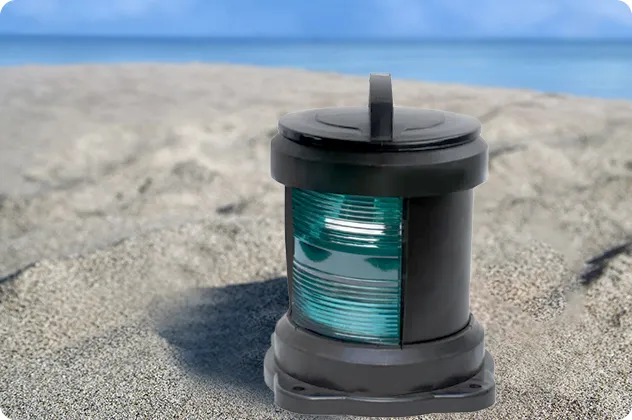
Where a specification fixes only one character, comparing a single-lamp luminaire such as the CXH1-3 marine navigation signal light against a multi-variant assembly becomes a documentation exercise as much as a technical one: the checklist is identical, but the number of variant records changes.
How does vessel speed relate to navigation light flash speed?
Speed in this context means the light's flash rate rather than vessel speed; vessel speed matters because it shortens the time an observer has to register flash cycles, so timing margin should be reviewed during sea trials rather than assumed.
Two effects are worth separating. The first is the observer's task: distinguishing a flashing character from a steady light, or one period from another, takes a number of cycles, so as closing speed rises the available observation window shortens. The second is geometric: a faster vessel passes through the published arc of visibility sooner, which makes arc coverage during each flash at least as important as flash count. This is reasoned inference about perception and geometry, not a sourced performance claim, and it should be tested on your own route with a stopwatch and a second observer, then filed in the sea-trial record.
How should procurement verify flash speed before awarding a contract?
Buyers should require, per variant, the specified flash character, the timing tolerance, the duty cycle limit, and a named test method, then confirm those points on a sample light before volume orders are released to the supplier.
A practical evidence pack contains four items:
- A timing declaration per catalogue number, covering period, tolerance, supply window, and operating temperature range.
- The test method and instrument class used, so your own goods-in inspection can reproduce the measurement.
- A configuration record for the delivered build, naming lamp type, lens colour, and controller version.
- Spare-part and check-interval guidance for the timing element.
Adjacent entries in the same published range state a standard reference and an ingress rating per model: the marine work light DS7-1M and marine wall light WB-1 records both cite JISF8414-2003 and IP56. That shows per-variant declarations are published for some lighting families here, but it is inference, not proof, that equivalent timing declarations exist for every navigation signal light listing, so the point must be confirmed rather than assumed; whether the same per-variant detail is published for CXH1-3P Aqua Signal navigation lights should be checked during quotation review.
Sourcing risk: series-level naming can hide variant differences. If a quotation lists only a family name, the timing declaration cannot be matched to the hardware delivered, and the mismatch can surface later, at sea trial rather than at goods-in inspection. Mitigation is procedural: contract on catalogue numbers rather than family names, make the timing declaration a deliverable document, and at arrival verify that nameplate and catalogue number match the accepted quotation, that a dockside timing check reproduces the declared period within tolerance, and that the configuration record matches the lamp and lens fitted.
FAQ
Does flash rate change when supply voltage moves?
It can. Electronic flashers typically hold their period inside a stated voltage window and drift outside it, while mechanical timers are usually less sensitive to voltage but affected by wear. Ask for the voltage window and the tolerance as separate figures, then test at the lowest expected supply voltage, which is often during battery discharge or a changeover.
Can incandescent and LED options be compared on the same timing checklist?
Yes, through the same four items: period, duty cycle limit, tolerance, and test method. They differ in how quickly full output is reached and how switching affects service life, so a short duty cycle that suits one source may stress the other. Compare measured on-time and colour stability at the fixture, not only the declared period.
What documentation evidences a navigation light's flash speed?
A variant-level timing declaration stating period, tolerance, duty cycle, supply window, and test method is the document to request first. Supporting evidence is a configuration record for the delivered build and, after installation, a sea-trial log with measured periods and voltages. Without the declaration, a catalogue figure cannot be matched to the delivered hardware.
Should flash timing be re-checked after lamp replacement?
Yes. Replacement can change start-up behaviour and load, which may shift effective on-time even when the controller setting is unchanged. A short timing check after any lamp or controller change keeps the record current and avoids disputes about whether the fixture drifted or the hardware changed.
Conclusion: Deciding on Timing Evidence
Marine navigation lights speed is judged more reliably as a timing system than as a single figure. The parameters that decide fitness are period, duty cycle, tolerance, and supply window; the choice that decides long-term behaviour is where timing lives and how easily it can be checked; the evidence that reduces procurement risk is a per-variant declaration matched to the delivered catalogue number.
For evaluation committees, the practical sequence is to fix the required character first, compare control architectures on documentation and serviceability second, and contract on measurements rather than descriptions third. Catalogue text cannot substitute for your own specification, and no timing value should be accepted without a test method your team can repeat.