Article Overview: This article explains the Marine Portable Light CSD2 and how its recorded ratings — 220V/24V, 60W, IP56, a rubber body, transparent colour and E27 or B22D lampholders — apply to temporary ship repair and cargo-handling work. It is written for engineering, operations and procurement readers. The evidence boundary is the supplied specification: illuminance, beam data, weight, test reports and certification are not recorded.
What Is a Marine Portable Light CSD2 Used For?
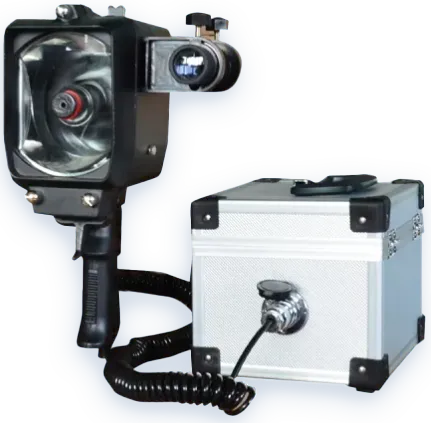
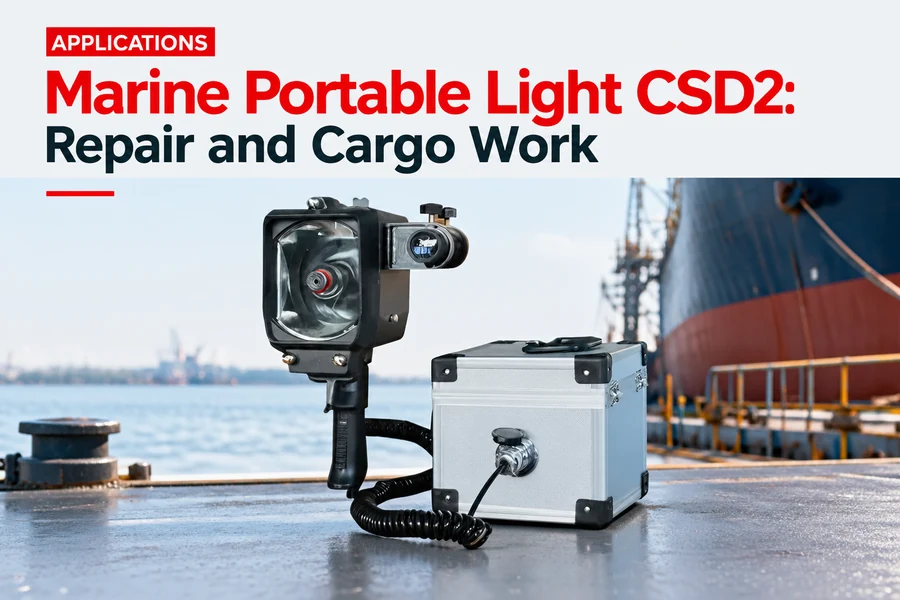
The CSD2 is a 60W portable marine light recorded for checking and repairing ship spaces and for loading or unloading goods at temporary work places, where a fixed fixture is absent or out of reach.
The supplied description records two tasks only: inspection and repair work on board, and cargo work at a temporary location. Both are situations where a mounted fixture cannot be placed where the work actually happens.
That scope has a boundary worth stating plainly. The description does not cover fixed lighting circuits, navigation signal lights or wiring design, and the CSD2 is not presented as a replacement for any of them. Where a compartment needs a permanent fitting, a fixed family applies instead; the catalogue range of marine fluorescent pendant lights with IP56 waterproof housings is one example of that category.
The recorded construction values are short: material rubber, colour transparent, IMPA codes 792151 and 792152. Impact resistance, operating temperature range and cable specification are not recorded and should be obtained from the supplier rather than assumed. The Marine Portable Light CSD2 product page publishes the voltage, power, IP56 rating and IMPA code values used throughout this article.
Can the CSD2 Marine Portable Light Run on 24V and 220V?
The recorded specification lists two voltage options for the CSD2, 220V and 24V, both at 60W. Which one applies depends on the supply available at the temporary work place, so the voltage has to be fixed at ordering rather than decided on board.
Other marine incandescent lights in the same catalogue follow that pattern, listing either a 24V or a 220V variant rather than a single universal input. The CSD2 therefore appears to be built per supply class, with each voltage treated as a separate build item.
The practical consequence is current draw. For a load taken as operating at unity power factor, the relationship is:
I = P ÷ V
where I is current in amperes, P is power in watts and V is voltage in volts. Using the recorded 60W rating, a 24V unit would draw approximately 2.5A and a 220V unit approximately 0.27A. These are arithmetic illustrations from the published rating, not measured values; if the fitting uses a driver with a power factor below unity, actual current exceeds this estimate.
Because the two currents differ by roughly an order of magnitude, the supply point feeding the lamp is a genuine check item. Circuit, protection and cable sizing belong with the vessel electrical documentation and are outside this article.
Why Does IP56 Matter on a Marine Portable Light?
IP56 records protection against dust ingress and against strong water jets, so a portable lamp used in wet deck, dripping or cargo areas is less exposed to the water and dust that shorten the life of an unprotected fixture.
The two digits are conventionally read separately. The first rates protection against solid objects and dust, where 5 indicates limited rather than complete dust exclusion. The second rates water, where 6 indicates protection against strong jets from any direction, not continuous immersion.
The product page describes the fitting as having a good waterproof function. IP56 is the checkable value, and it is the figure worth carrying into a specification or requisition.
One limitation applies: the supplied evidence records the rating but not the test certificate or the sealing method. Where a formal submittal is required, obtain the manufacturer declaration for the delivered variant rather than relying on the catalogue figure.
Scenario Matrix: Recorded Attributes Against Work Situations
Temporary work positions differ, and the supplied specification is detailed enough to test a few common ones before ordering. The table maps recorded attributes to the checks each situation raises; it is a comparison aid, not a performance guarantee.
| Work scenario | Relevant recorded attribute | Check before ordering or use |
|---|---|---|
| Repair work in a wet or dripping space | IP56 protection, rubber body | Confirm the delivered variant rating and that the enclosure is undamaged on arrival. |
| Cargo loading or unloading at night | 60W lamp, transparent colour | Confirm the working position is served by the voltage variant ordered. |
| Work that shifts between decks during a job | Light weight, removable lamp body | Confirm that movement and isolation follow the vessel own procedures. |
| Bulb renewal and spare stock | E27 or B22D lampholder | Confirm which lampholder the delivered unit carries before stocking bulbs. |
| Requisition and record keeping | IMPA codes 792151, 792152 | Confirm which IMPA code corresponds to which lampholder variant. |
The matrix stops where the evidence stops: illuminance, beam pattern, colour temperature and lamp life are not recorded in the supplied specification, so no photometric or lifetime comparison can be drawn from it.
How Do You Move a Marine Portable Light Between Temporary Work Places?
The recorded design combines low weight with a lamp body that can be removed, so the CSD2 can be repositioned between temporary work places instead of being remounted at each location.
The description records a light weight and a lamp body that is convenient to remove. No figure in kilograms and no mounting bracket are given, so the sequence below describes the handling implications of that design rather than a manufacturer procedure. Isolation and live-work rules remain governed by vessel procedure and are not covered here.
Step 1: Confirm the supply at the new position
Establish whether the new working position provides 220V or 24V and match it to the variant on hand. The two variants are not interchangeable in service.
Step 2: Isolate and release the lamp body
The removable lamp body is what makes transport practical. The isolation method and the permission to move the unit are set by vessel procedure, not by the product description.
Step 3: Transport to the new position
The unit is described as light, but the specification records no weight, so no handling limit should be derived from the description.
Step 4: Reinstate and confirm seating
Reconnect to the matching supply, confirm the lamp is correctly seated in its E27 or B22D lampholder and check that the enclosure has not been disturbed in transit.
Routine checks between movements, including cleaning the enclosure, inspecting the lampholder and confirming seals, are covered in the marine portable light maintenance guidance for CSD7 searchlights, which follows the same IP56 protection logic.
E27 or B22D: Which Lampholder Does the CSD2 Accept?
The recorded specification lists both E27 and B22D lampholders, so the lampholder is a variant decision at ordering rather than a fixed characteristic; which replacement bulbs fit is determined by the unit delivered.
Because the two designations refer to different lamp base types, a bulb that fits one variant will not fit the other. The specification does not state base dimensions or a bulb type beyond a reference to an energy-saving lamp, so replacement parts should be confirmed against the variant in hand.
- Lampholder
- The socket that accepts the lamp, recorded as E27 or B22D for the CSD2.
- IP56
- The recorded enclosure protection rating for the CSD2.
- Voltage variant
- The recorded supply class of the unit, either 220V or 24V.
- IMPA code
- Catalogue reference used in marine requisitions; 792151 and 792152 are recorded for the CSD2.
For procurement, the failure mode is a mismatch between three fields that are easy to treat as one: voltage, lampholder and IMPA code. A requisition that names only the model leaves voltage and lampholder open. Naming the voltage variant, the lampholder and the corresponding IMPA code, and asking the supplier to confirm that mapping on the order acknowledgement, removes most of the ambiguity.
A smaller risk is spares. With two lampholder options and two voltage options, one lamp model covers four combinations, so bulb stock planned against one combination will not serve the others, and the spares list should follow the as-delivered variant.
FAQ
Is the CSD2 rated for use in hazardous or explosive atmospheres?
The supplied specification records voltage, power, IP56 protection, material, colour, lampholder options and IMPA codes. It records no explosion-proof or hazardous-area certification. Unless the supplier provides documented evidence for the specific hazardous-area classification concerned, this lamp should not be assumed suitable for such locations.
What IMPA codes are recorded for the CSD2?
The product page lists two IMPA codes, 792151 and 792152. The supplied evidence does not state which code corresponds to which lampholder or voltage variant, so the mapping should be confirmed with the supplier before the code alone is used in a requisition.
Does the CSD2 ship with a lamp and a cable?
The description refers to an energy-saving lamp and records transparent colour and a rubber body, but the supplied specification does not list accessory contents. Bulb inclusion, cable length, plug type and mounting accessories should be confirmed on the supplier datasheet or quotation rather than assumed.
How does a portable light differ from a fixed marine work light?
A fixed work light is mounted where the work normally happens and stays there, while the CSD2 is recorded for temporary work places where lighting has to follow the task. The two roles are complementary, and the choice depends on whether the working position is predictable or changes from job to job.
Conclusion: Fitting the CSD2 to Temporary Work
The Marine Portable Light CSD2 is a 60W portable unit recorded for two jobs: checking and repairing ship spaces, and lighting cargo loading or unloading at temporary work places. Its usable specification is compact, and the decisions that matter are made at ordering rather than at the work position.
Three checks carry most of the weight. Match the voltage variant to the supply available where the lamp will be used, because the current difference between 24V and 220V is substantial. Fix the lampholder option and the corresponding IMPA code on the requisition so bulbs and spares line up with what is delivered. Treat IP56 as a claim worth confirming with documentation for the delivered variant when the project requires a formal submittal.
Where the evidence is silent, which includes illuminance, beam pattern, weight, cable specification, accessory contents and certification, the correct next step is a documented question to the supplier rather than an assumption carried into a purchase order.