Article Overview: This article examines the Marine Work Light DS7-1M series as recorded in published product data, where the family carries a JISF8414-2003 standard reference and an IP56 protection rating across five variants. It is written for technical buyers, engineering managers and procurement teams planning inspection and acceptance checks. The conclusion is that recorded references define what to verify, not what has been proven, and the discussion stays inside the published specification without reproducing standard text or asserting third-party certification.
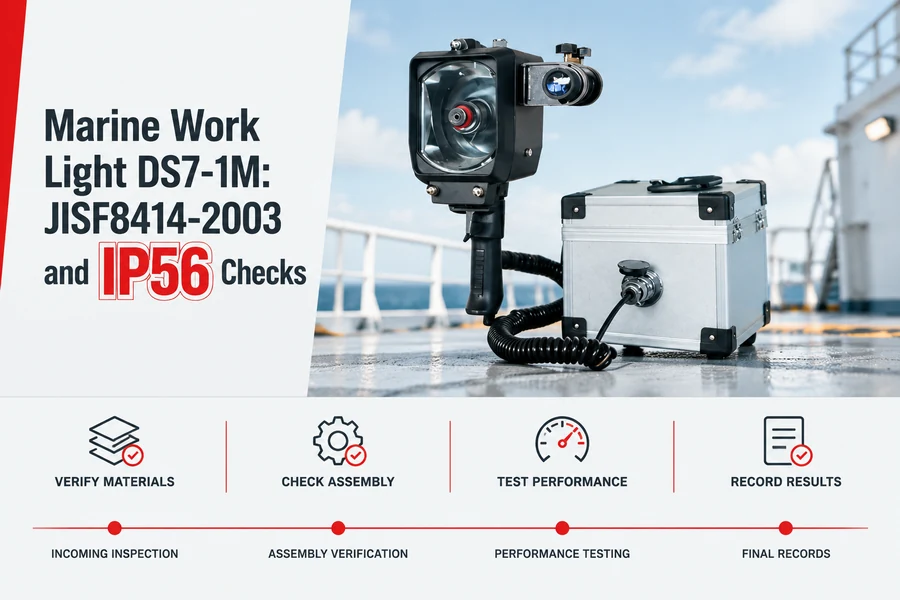
What Does the JISF8414-2003 Reference Mean for a Marine Work Light?
On the DS7-1M series, JISF8414-2003 is the standard reference recorded alongside the model, voltage, power and IP56 data. It identifies the specification the manufacturer associates with the lamp; it is not, by itself, proof of third-party compliance.
The reference sits in the same data block as the electrical and protection values, which makes it a declaration of a specification family rather than a statement about testing. The published page names no issuing body, certificate number or test method, so the buyer's first action is a documentation request: which document accompanies the reference, who issued it, and which model designations it covers.
- JISF8414-2003
- The standard reference recorded in the DS7-1M specification block, listed beside the model, voltage and power values.
- IP56
- The protection rating recorded for all five DS7 variants; the first digit addresses solid-object protection and the second addresses water protection.
- IMPA code
- The catalogue reference recorded per variant and colour, used to match a purchase order line to one specific model.
- Lampholder
- The lamp base the fixture accepts: FB15 for DS7-1M, E27 for the remaining variants.
The same reference appears on other incandescent fixtures in the published catalogue, including the WB-1 and WB-2 wall lights listed at 24V/15W and 220V/60W with the same IP56 entry. Read together, those pages suggest a family-level declaration rather than evidence tied to one lamp model, which is an inference from the recorded data and not a statement about how the manufacturer documents testing.
Where an order needs the exact recorded values, the recorded DS7-1M series specification with its JISF8414-2003 and IP56 entries lists voltage, power, lampholder and IMPA code for all five variants.
How Do I Verify IP56 on a Marine Work Light Before Installation?
IP56 verification starts with the recorded claim on the series page, then moves to the delivered unit: confirm the model marking and IMPA code, inspect the resin housing and lamp cover for cracks or distortion, and log the result.
Both digits describe enclosure properties, and both can be degraded by installation practice. An incomplete cable entry, a distorted cover or a mounting position that traps water will not appear in any catalogue entry, which is why the physical check matters more than the page value once the fixture is on site.
The DS7 page ties the rating to defined space types: illumination for areas with water dripping, water spattering, water coagulating and weather exposure, naming oven cabins, dry cabins, pipe tunnels and weather decks. The mounting point should match one of those conditions, because a rating checked against a different environment proves nothing about the installation.
Documentation is the second half of the check. The published page records the rating but no test report, issuing laboratory or certificate number, so any requirement for documented ingress testing has to be raised with the supplier and confirmed before award. Where the same IP56 entry appears across several fixture families, a like-for-like read helps; a comparison of IP56 marine lighting models across the range sets the recorded values of the different families side by side.
Which DS7-1M Work Light Variant Matches a Given Power Requirement?
The recorded series maps five options to four power ratings: DS7-1M is 24V/15W, DS7-2M and the W model are 220V/60W, DS7-3M is 220V/100W, and DS7-4M is 220V/200W at 220V.
| Model | Voltage | Power | Lampholder | Colour options | IMPA codes |
|---|---|---|---|---|---|
| DS7-1M | 24V | 15W | FB15 | Transparent, red, green | 792053, 792054 |
| DS7-2M | 220V | 60W | E27 | Transparent, red, green | 792057, 792058 |
| DS7-3M | 220V | 100W | E27 | Transparent, red, green | 792059, 792060 |
| DS7-4M | 220V | 200W | E27 | Transparent, red, green | 792061, 792062 |
| DS7-W | 220V | 60W | E27 | Transparent | 792066 |
Voltage compatibility is the first filter, not wattage. A 24V DS7-1M and a 220V DS7-2M reflect different supply arrangements at the mounting point, so the available supply is confirmed before the wattage question is asked. Once the supply is fixed, the choice narrows to the two 220V/60W entries or the higher-rated DS7-3M and DS7-4M.
Wattage is input power, not light output. The page records no lumen or illuminance figures, so an illuminance-based specification cannot be closed from the published data alone. Treat the 15W to 200W span as a comparative indicator of input power and request a photometric document that names the exact variant before committing to a lighting level.
Two smaller recorded differences are worth noting. The W option pairs the 60W rating with a transparent cover only, so a red or green signal colour points to DS7-2M at the same wattage. Housing material is listed as synthetic resin for all five variants, so material does not separate them.
Work lights also form only one line in a ship lighting schedule. Where a cabin, corridor or machinery space is better served by a linear fitting, the marine fluorescent pendant lights (JCY and JJY series) cover that part of the range, and the same questions about recorded ratings, colour options and per-model codes apply there.
What Should Be Checked When a Marine Work Light Shipment Arrives?
Recorded page data supports a four-part arrival check: confirm the model and IMPA code against the order, inspect the synthetic-resin body and lamp cover, verify the lampholder type, and compare the voltage and power marking with the recorded specification.
Step 1: Reconcile the marking with the order line
Read the model and IMPA code on the unit and the packing list against the purchase order. Because five variants share one specification page but carry distinct codes, a wattage or colour mismatch is easiest to catch here. Outcome: a signed-off order line or a written discrepancy note.
Step 2: Inspect the housing and lamp cover
Check the synthetic resin body and cover for cracks, deformation or incomplete moulding, and confirm the delivered colour matches the order. Outcome: dated photographs attached to the receipt record.
Step 3: Confirm the electrical interface
Verify that the lampholder matches the recorded value, FB15 for DS7-1M and E27 for the other variants, and that the voltage and power marking agrees with the ordered model. Outcome: mismatches are raised before wiring, not after commissioning.
Step 4: Build the acceptance record
File the packing list, the supplier declaration as issued, arrival photographs and a note of the mounting location and sealing condition. Outcome: a traceable file that supports later maintenance and warranty discussion.
Arrival inspection confirms what was delivered and how it looks; it is not a certification process and it does not test the enclosure against the declared rating. Where a project requires that test evidence, the requirement belongs in the purchase specification rather than in a receiving checklist.
What Acceptance Evidence Should Be Kept on File?
Keep the order line, the supplier declaration referencing the recorded standard and IP rating, the packing list showing model and IMPA codes, and dated arrival photographs of housing, cover and marking for each unit.
The file should let someone who was not involved reconstruct what was ordered and what arrived. Two gaps deserve explicit handling rather than assumption. The published data records a rating and a standard reference but no test report or certificate number, so documented testing must be requested if the project requires it. The published data also omits installation instructions, cable gland specifications and mounting dimensions, all of which influence whether the declared protection survives installation.
Three questions close most of the remaining uncertainty during supplier discussions: which document accompanies the standard reference; whether the IP56 declaration is model-specific or family-level; and whether a photometric datasheet exists for the exact variant being ordered. The answers decide whether the fixture can be accepted on documentation or has to be verified on site.
FAQ
Does the JISF8414-2003 entry mean the DS7-1M is certified?
No. The entry records a standard reference on the product page; it does not state who tested the lamp, under which scheme, or with what result. Certification status has to be confirmed by a document issued for the specific model. Treat the page entry as the reason to request that document, not as a substitute for it.
Can a 24V DS7-1M replace a 220V work light on the same circuit?
Not directly. The recorded variants separate the 24V/15W DS7-1M from the 220V models at 60W, 100W and 200W. Supplying a 24V fixture from a 220V circuit, or the reverse, is an electrical mismatch, so the supply available at the mounting point is confirmed before a variant is selected.
What do the colour options change on a DS7 work light?
The recorded data lists transparent, red and green for DS7-1M through DS7-4M, while the W variant is listed as transparent only. Colour options are tied to separate IMPA codes, so colour has to be stated on the order line; otherwise the delivered code may match the model but not the intended colour.
Which lampholder should I expect on each variant?
The recorded data shows FB15 for DS7-1M and E27 for DS7-2M, DS7-3M, DS7-4M and W. Because the lampholder determines which replacement lamp fits, it is worth confirming at receipt and recording in the maintenance file, particularly where spare lamps are held on board.
Conclusion: Verify the Recorded Claims Before You Rely on Them
The DS7-1M family records four verifiable facts: a JISF8414-2003 standard reference, an IP56 protection rating, five variants spanning 15W to 200W, and per-colour IMPA codes that tie each order line to one model. None of those entries replaces a document issued for the specific unit, and none of them substitutes for a photometric or ingress test record when a project requires one.
The practical sequence is consistent across the family: confirm voltage first, request the document set that accompanies the standard reference, inspect housing, cover, lampholder and marking at receipt, and file dated evidence against the order line. Buyers who follow that sequence know what they have; buyers who rely on the page entry alone know only what was published.