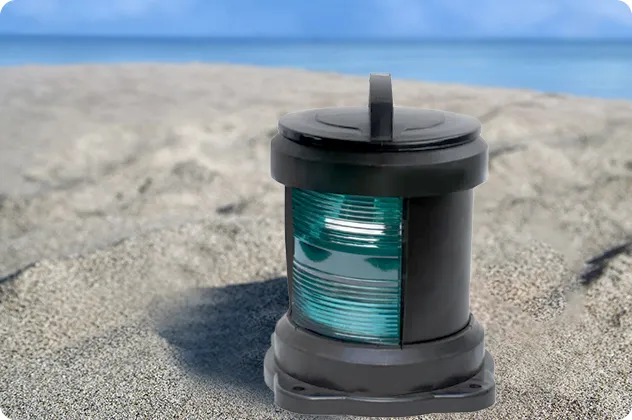
Article Overview: This procurement guide helps procurement managers, sourcing teams, and project engineers evaluate the Marine Navigation Signal Light CXH17 before issuing an RFQ. The core question is how to translate vessel needs into verifiable product requirements. The conclusion is to match the published CXH17 specification to your electrical system and installation environment, then verify supplier evidence. The evidence boundary is the manufacturer's published CXH17 datasheet and related product pages included in this evaluation.
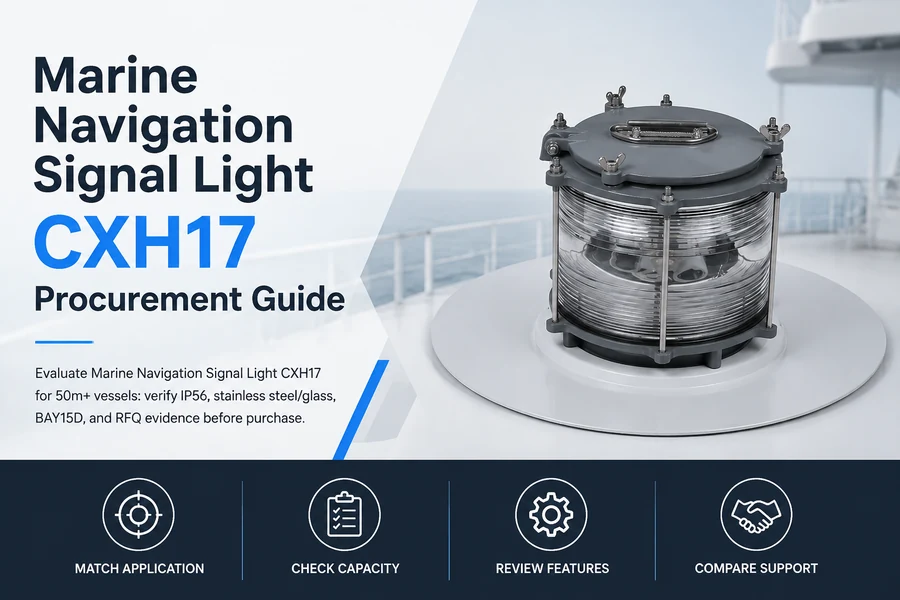
How Should Buyers Choose the Marine Navigation Signal Light CXH17?
Start with the operating environment and vessel length, then match voltage, wattage, protection class, material, and lamp holder to the published CXH17 specification before comparing suppliers.
The CXH17 product page states that the light is used in ships with a length of 50m or above as a signal light during night navigation. That application statement is the first screen: if your vessel is shorter, the CXH17 may not be the right reference point. The page does not say whether the unit is configured as a masthead, side, or stern light, so the intended signal position must be confirmed with the supplier before you treat the model as a drop-in replacement.
To turn the published data into selection criteria, use the following decision parameters.
- Vessel length
- Published for ships 50m or above.
- Voltage
- 220V or 24V; confirm which configuration is quoted.
- Power
- 60W.
- Protection class
- IP56.
- Housing material
- Stainless steel with a glass lampshade.
- Lampholder
- BAY15D.
- Weight
- 1.8 kg.
These values are the minimum content for an RFQ line item. Any supplier that cannot confirm the same numbers in writing should be moved to a secondary list. Start by reviewing the published Marine Navigation Signal Light CXH17 specification so your evaluation starts from the manufacturer's own data rather than a reseller summary.
The page lists color options as transparent, red, and green. If your application requires one specific color, write that requirement into the RFQ so the supplier does not default to a mixed-color package.
For vessels under 12m, the application profile changes. The related Aqua Signal Navigation Lights CXH1-3P models are marketed for ships below 12m, which is a useful cross-check when you are buying for a mixed fleet and need to separate navigation-light categories by length.
What Should You Verify Before Ordering the CXH17?
Verify the electrical system voltage, lamp holder type, IP rating, housing material, glass specification, and the intended navigation-light function against the supplier's written quotation and product drawings.
Verification is not a single step. For the CXH17, the evidence you need falls into five categories:
- Written specification match: the quotation must list model CXH17 and the same voltage, power, protection, material, and lampholder values as the product page.
- Electrical interface: identify whether the order is for the 220V or 24V version and whether the vessel's circuit can supply it without conversion.
- Mechanical interface: confirm mounting dimensions, cable entry position, and clearance around the agraffe-type structure for bulb access.
- Environment fit: IP56 provides a defined protection level, but the actual deck location, salt exposure, and vibration should be compared with the supplier's stated limits.
- Spare parts and maintenance: ask about replacement glass, bulbs for BAY15D, gaskets, and the recommended service interval.
The goal is to avoid accepting a model number as a complete specification. For this product, the practical acceptance check is a comparison between the RFQ line item, the supplier's datasheet, and the inspection method for the IP56 claim.
If the supplier cannot provide a drawing or a description of the agraffe mechanism, treat the maintenance claim as unverified. The same applies to the glass lampshade: ask whether replacement glass is available and how the lampshade is retained.
Which CXH17 Trade-Offs Matter Most During Supplier Evaluation?
The main trade-offs are voltage compatibility, lamp holder standardization, housing durability versus weight, protection rating, and maintainability of the glass and bulb assembly. For most procurements, protection and installation compatibility outweigh minor price differences.
Do not evaluate the CXH17 as an isolated part. The trade-offs that matter depend on your fleet's electrical standard and deck layout.
- Voltage versus fleet standardization: If your vessel uses 24V navigation circuits, a 220V stock item is useless regardless of price. Confirm voltage availability before comparing any other attribute.
- Lampholder standardization: BAY15D is a bayonet base, but confirm that your maintenance team stocks the corresponding bulbs. A different base across suppliers increases spare-parts complexity.
- Material and weight: The CXH17 uses stainless steel and glass, with a published weight of 1.8 kg. This may be sturdier than plastic alternatives, but it also affects the mounting bracket and top hamper load. Choose based on corrosion exposure and structural capacity.
- Maintainability: The product description highlights an agraffe-type impacted structure for easy installation and bulb replacement. Confirm this in the drawing, because serviceability directly affects crew time.
A sourcing error to avoid is comparing unit prices before confirming that all offers use the same voltage version. For the CXH17, a 24V unit and a 220V unit are different products for inventory purposes even when the model number is identical. Add the voltage code to the part number in your purchase order.
For a mixed-fleet setting, compare the CXH17 with lights designed for smaller vessels, such as the Aqua Signal Navigation Lights CXH1-3P, and with interior units when procurement is consolidated. These comparisons are useful for identifying whether one supplier can cover both deck signaling and cabin lighting; if so, the Marine Incandescent Pendant Light CCD6-2 Plastic may be relevant to the same RFQ cycle.
Build an RFQ Checklist Around the CXH17 Specification
An RFQ is the moment when operating requirements become contractual requirements. Use the following process to keep the CXH17 procurement decision reproducible.
Step 1: Define the application
Record vessel length, signal function, mounting location, and operating voltage. State whether the CXH17 is for new construction or replacement.
Step 2: Fix the technical baseline
Write the CXH17 parameters into the RFQ: voltage 220V/24V, power 60W, IP56, stainless steel and glass, BAY15D, weight 1.8 kg, and available colors.
Step 3: Request evidence
Ask for a datasheet, installation drawing, material description, and the method used to verify the IP rating. Request a sample or inspection report before a full order.
Step 4: Check spare parts and logistics
Confirm replacement glass, bulb type, gasket availability, packaging for export, and delivery terms. Record these in the commercial proposal.
Step 5: Review supplier answers
Compare supplier responses against the same checklist. Do not rank offers on price before confirming that all technical fields match the published specification.
When suppliers return quotations, create a comparison table with one row for each parameter in the flow-block above. If any cell is blank, ask for clarification before evaluation. This makes the decision auditable and reduces the chance that a verbal assurance replaces written evidence.
FAQ
Is the CXH17 only for ships 50 meters and above?
The product description states that the CXH17 is used in ships with a length of 50m or above as a signal light during night navigation. If your vessel is shorter, evaluate lights designed for that length range and confirm the intended signal position with the supplier before purchase.
What does the BAY15D lampholder mean for bulb replacement?
BAY15D is a bayonet-style base. Confirm that the specified bulb is available for your voltage version and that replacement bulbs or complete lamp assemblies are included in the quotation. The lampholder must match the bulb and the fixture wiring.
Should I request the 220V or 24V version of the CXH17?
The model is published with both 220V and 24V options. Choose the version that matches your vessel's navigation-light circuit and state it explicitly in the RFQ. Ask the supplier to confirm the voltage on the quotation and product label before shipment.
What documents should a CXH17 supplier provide with a quotation?
Request a product datasheet, installation drawing, material description, and the test method used to support the IP56 rating. Also ask how the agraffe structure and glass lampshade are serviced. Confirm any type approval in writing rather than assuming it exists.
Conclusion
Selecting the Marine Navigation Signal Light CXH17 is a verification exercise, not a price comparison. Use the published specification as your baseline, confirm the voltage version, check the BAY15D and IP56 details, and request drawings plus inspection evidence before committing to an order. For a mixed fleet, compare the CXH17 with other navigation lights by length class and consolidate supporting lighting products only when the technical data supports the match. This approach reduces the risk of receiving a non-conforming unit that delays installation or creates a safety issue during night navigation.