Article Overview: This comparison supports CTOs, technical architects, and procurement teams evaluating the CSD7 handheld marine searchlight against fixed marine lighting alternatives. It answers whether portable or installed units fit temporary cargo handling and permanent operations, using only published specifications and clearly labeled trade-offs.
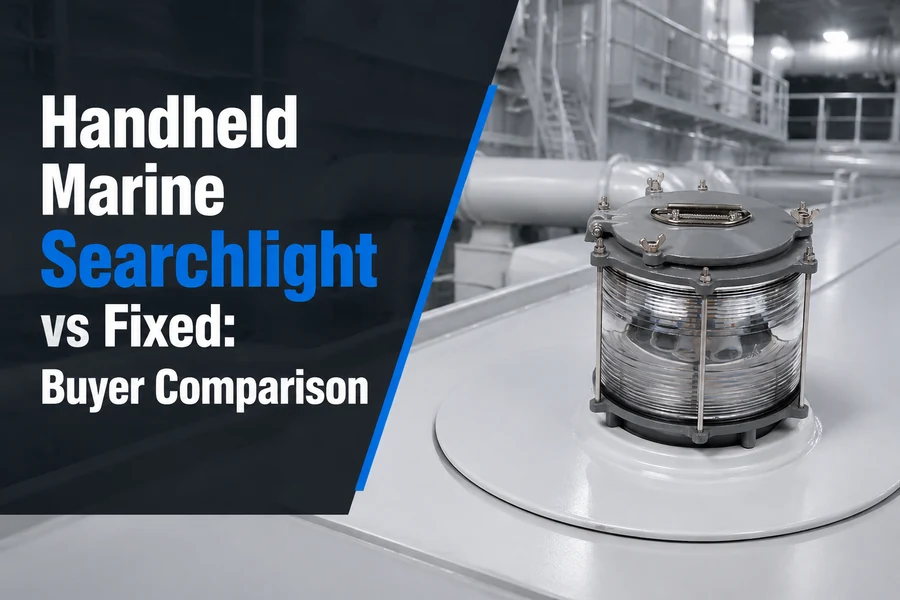
Handheld Marine Searchlight vs Fixed: What Are the Advantages?
A handheld marine searchlight provides mobility, flexible positioning, and simple storage because it can be carried to temporary work areas and aimed manually. Fixed lights require permanent mounting and wiring, making them less adaptable to changing tasks.
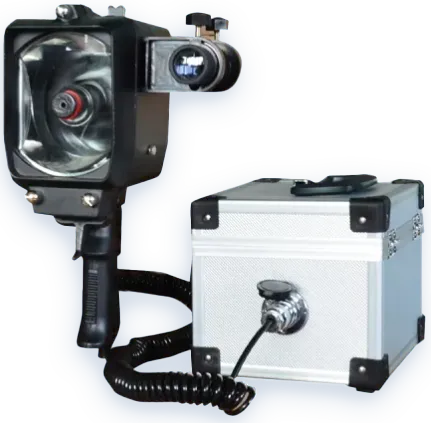
Portable units such as the Handheld Marine Searchlight CSD7 are intended for checking, repairing, or loading and unloading goods at temporary work places. The CSD7 specification includes 220V or 24V supply, 60W incandescent power, an E27 lampholder, and an IP56-rated phenolic plastic shell with a glass lampshade and protective net. The rubber handle suits repeated handling. These parameters describe a unit that can be moved to the work point instead of being wired into a fixed location.
Decision checkpoint: mobility and storage
Handheld (CSD7): Carried to the work point, aimed by the operator, and stored in a locker when not needed. No mounting brackets or dedicated cabling are required.
Fixed alternative: Mounted on a deck, bulkhead, or overhead structure and connected to the ship's supply. It stays in place for repeated operations but cannot follow the crew to another location.
Buyer note: If the work zone changes between holds, decks, or gangways, a portable unit avoids installing multiple fixtures. If the light must support the same task every day, a fixed installation reduces handling time.
For temporary work, the portability advantage is primarily operational. Crew can reposition the beam without returning to a switchboard, and the unit can be shared across departments. Ease of storage is a practical benefit because the CSD7 uses a compact plastic body; however, the supplier does not publish dimensions or weight, so verify physical size against locker space before ordering.
When Should I Choose a Fixed Searchlight Instead of a Portable CSD7?
Choose a fixed searchlight when the illumination task is permanent, requires continuous operation, or demands higher intensity that a 60W portable unit cannot provide. Permanent mounting also reduces setup time for recurring operations such as cargo holds or deck work stations.
Fixed or permanently assigned marine lights are better suited to locations where the same area must be lit every shift. The Marine Cargo Light CGD2, for example, is described as a movable light for cargo warehouse illumination with a steel housing and a 300W or 500W incandescent bulb. That higher wattage indicates an ability to cover a larger area than a 60W handheld unit, although lumen output and beam distance are not published.
Key specification comparison
| Criterion | Handheld CSD7 | Marine Cargo Light CGD2 |
|---|---|---|
| Voltage | 220V / 24V | 110V / 220V |
| Power | 60W | 300W / 500W |
| Protection | IP56 | IP20 |
| Material | Plastic | Steel |
| Lampholder | E27 | E40 |
| Weight | Not published | 3.6 kg |
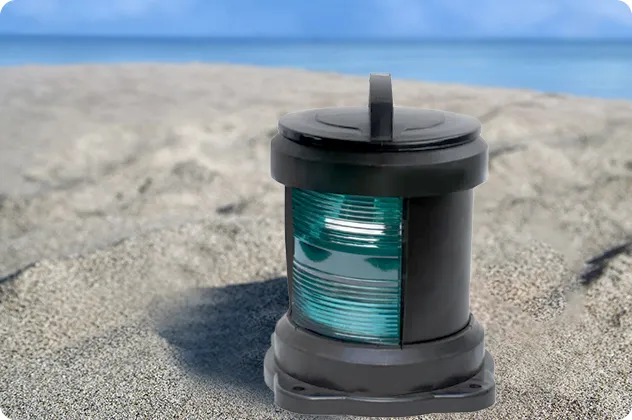
The table shows a trade-off rather than a clear ranking. The CSD7 provides better ingress protection (IP56) and lower power consumption, while the CGD2 offers much higher wattage and a steel body for rough service. A permanently installed pendant such as the Marine Incandescent Pendant Light CCD6-2 Plastic is another option for wet deck and cabin use, with the same 60W power and IP56 rating as the CSD7 but no portability. That comparison illustrates that "fixed" does not automatically mean more powerful; the right choice depends on whether the operating zone is permanent and whether high area illumination is required. When specifying a fixed unit, also verify mounting surface, cable entry, and whether the fixture can withstand vibration in the intended installation area.
How Does the Brightness of the CSD7 Compare to Fixed Marine Floodlights?
Published specifications do not include lumen output or beam distance for the CSD7 or for available fixed alternatives, so brightness cannot be directly quantified. Wattage indicates the CSD7 60W unit is intended for close-range portable work, while higher-wattage cargo lights can illuminate larger areas.
Brightness comparison is constrained by missing photometric data. Neither the CSD7 page nor the cargo light pages list lumens, beam angle, or effective range in the evidence reviewed. What can be compared is rated electrical power: 60W for the CSD7 versus 300W/500W for the CGD2. For incandescent lamps within the same technology family, higher wattage normally corresponds to higher light output, but reflector design, lamp condition, and operating voltage also affect real results.
- For close-range inspection: The 60W CSD7 is positioned as a portable work light, not a high-intensity area floodlight.
- For large-area deck or hold illumination: A higher-wattage cargo light is the more relevant choice, but verify its IP20 rating means limited protection against water and dust.
- For comparative procurement: Ask the supplier for a documented photometric test or a side-by-side demonstration before selecting on wattage alone.
Because beam distance is not published, any stated throw length in a marketing sheet should be treated as an unverified claim unless supported by a test report. This is a sourcing risk for both categories. Mitigation steps include requiring a datasheet with lumens and beam angle, sampling units for trial, and testing in the intended mounting position.
Which Type of Searchlight Is More Cost-Effective for Temporary Cargo Handling?
For temporary cargo handling, a handheld searchlight is usually more cost-effective because it avoids permanent installation and moves between holds and decks. Total cost depends on bulb life, setup labor, and whether a fixed cargo light already exists.
Cost-effectiveness cannot be reduced to a single price figure because the available evidence does not include purchase prices or installation rates. Instead, the buyer should model the work pattern and ownership costs. Use the following evaluation flow:
Step 1: Define operating zone and frequency
List the holds, decks, or shore-side areas where cargo handling occurs. If locations vary weekly, portable deployment avoids duplicate fixtures.
Step 2: Estimate installation and cabling scope
For a fixed unit, include mounting hardware, cable runs, switch integration, and any structural work. For a handheld unit, include only the cost of the light and a convenient power outlet or extension arrangement.
Step 3: Compare maintenance and spares
The CSD7 uses an E27 lampholder, which is common for replacement bulbs. The CGD2 uses an E40 lampholder and a heavier steel housing; verify spare-bulb availability and replacement labor for both.
Step 4: Decide based on fleet standardization
If the vessel already has fixed cargo lights or pendant lights, adding one portable CSD7 may be more economical than rewiring a new fixed point. If multiple ships need identical permanent lighting, standardization across fixed units may reduce training and spares overhead.
For purely temporary cargo handling, the portable approach avoids the sunk cost of installation. For continuous operations, the fixed approach may have lower per-shift labor because the light is always in position. The decision hinges on task frequency, available power points, and the crew's willingness to set up and stow portable equipment.
FAQ
Can the CSD7 handheld searchlight be used on wet decks?
The CSD7 carries an IP56 protection rating, which indicates a defined level of protection against water and dust. Confirm the exact IP test conditions with the manufacturer before relying on it in prolonged heavy rain or sea spray.
What voltage should I choose for a portable marine searchlight?
The CSD7 is offered in 220V and 24V versions. Select 24V for existing low-voltage shipboard circuits or 220V when the vessel supplies that standard. Verify cable length and voltage drop before deployment, since long extension runs can reduce lamp brightness.
Is a fixed marine light always brighter than the CSD7?
Not necessarily. Published data for both categories lacks lumen output and beam distance. A 300W/500W cargo light can provide more incandescent output than a 60W handheld, but an installed pendant with the same 60W rating will not be brighter. Compare photometric data rather than assuming mounting position determines performance.
Conclusion: Choose by Operating Pattern, Not by Portability Alone
The decision between a handheld marine searchlight and a fixed alternative depends on task frequency, required area coverage, and installation constraints. The CSD7 is the stronger fit for temporary cargo handling, inspection, and repair work because it is portable, IP56-protected, and uses a common E27 lampholder. A higher-wattage cargo light such as the CGD2 fits continuous or large-area illumination despite its lower IP20 protection. Permanent fixed lights make sense only when the work zone is stable and the installation cost can be amortized over frequent use. Because lumen output and beam distance are not published, procurement should require photometric evidence before committing to a brightness-dependent application.